r/Assyria • u/bankstown_resident • 13h ago
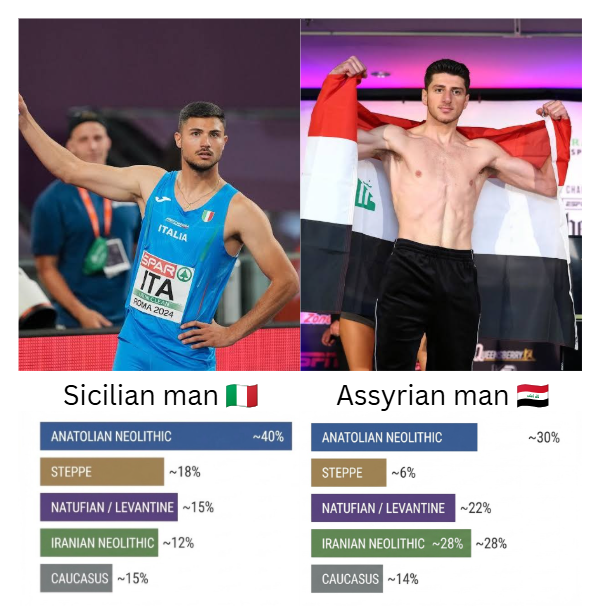
Discussion Intersting how DNA wise it's real close
7
Upvotes
r/Assyria • u/bankstown_resident • 13h ago
r/Assyria • u/Past_Schedule5526 • 20h ago
Hi all, I didn't know where to post this. My stepdaughter is participating in an upcoming United Nations celebration Day at her elementary School. Her family background is Chaldean, and she really wants to represent that culture in the celebration.
I know next to nothing about the Chaldean people and I'm learning slowly but surely. I still want to support her in representing them. I don't know the best way to get traditional clothing or the significance of the different clothing styles.
Can anyone here please point me in the right direction? It would make her so happy to be able to represent the Chaldean culture at her school.
r/Assyria • u/Specific-Bid6486 • 20h ago
I often have to remind myself that we are a fragmented nation due to churches and the many denominations that we have built over the centuries. But, this doesn’t mean we have to follow the teachings of the early church fathers and what they thought was factual to be our only way to make sense of the world and how we view ourselves.
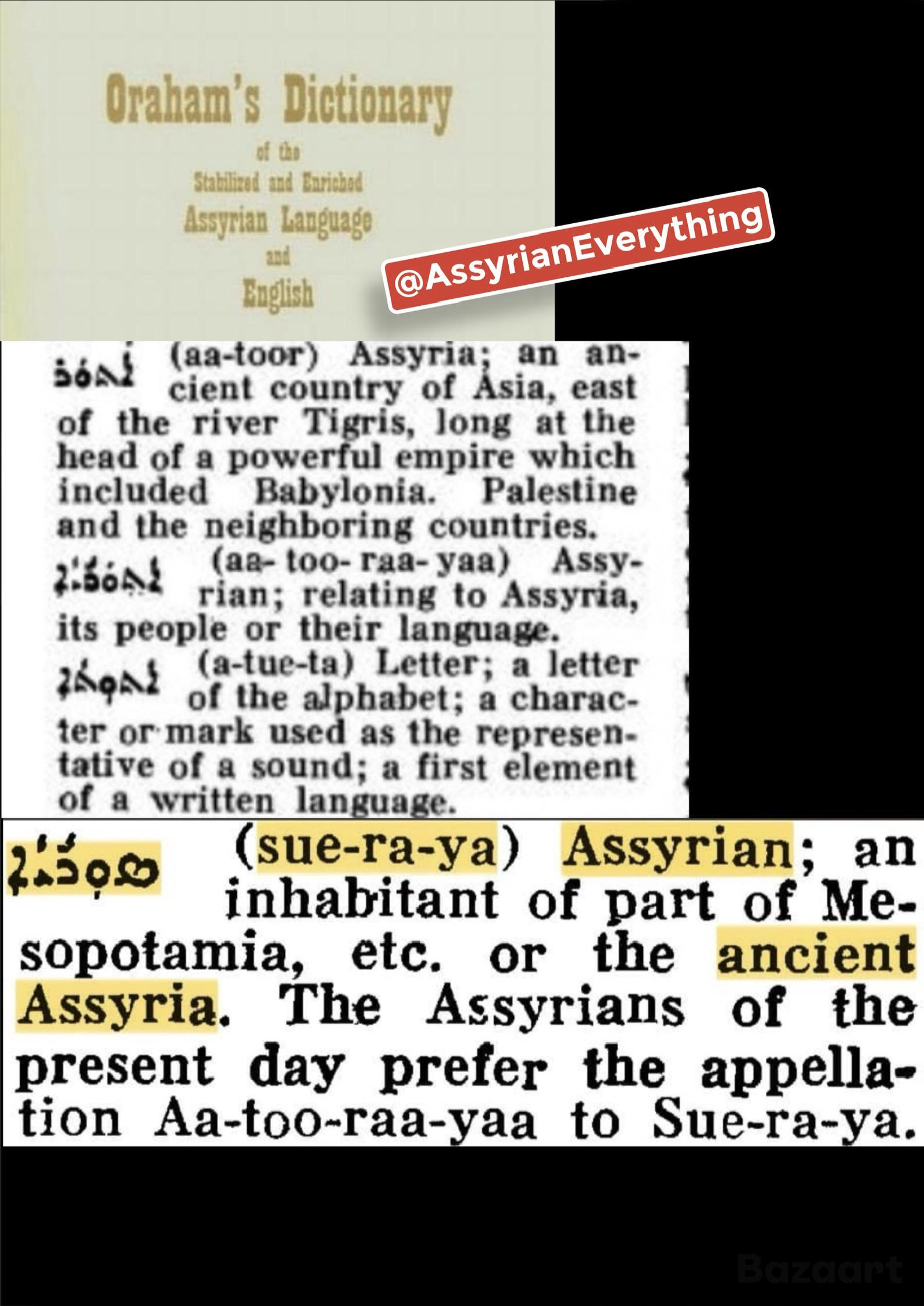
I know the early church fathers often used this term to make it sound like it means Christian. But I think this is creating a problem for future generations to understand their roots. This is why we also have the word, M’shekhaya, which is the CORRECT and proper label for Christian. If you label yourself Suraya and use the same term for other ethnicities out there and say that are Suraya, you are essentially relinquishing your heritage and namesake to be flexible. This is how we muddle the waters b/c now this label is no longer relevant to your culture’s heritage and anyone who follows the Christian faith can exclusively use this term.
Take for example the label “Semitic” as we are often grouped with this label as it stems from “Shem”, one of the 3 sons of Noah that supposedly Assyrians were born from. When you go far back into its roots, this is where the label Semitic comes from. Today it’s used for languages but it’s also used for heritage to tie a people to the ANE. This word is also misleading to our nation since it has no bearing on human evolution and how humanity evolved and migrated throughout history to how we ended up in măt-Aššur.
At the end of the day, nobody can force anyone to believe this but it takes time to educate oneself and know that the word Suraya is much more older than the Pešitta and when it was written down and how the early church fathers viewed our beginnings which is false and doesn’t have any evidence to back it up.
Lastly, being labelled as an “ethno-religious” group or community, solely, is false and also misleading other Assyrians to accept only Assyrians that adhere to the Christian faith and ostracise others if they don’t agree with the faith. If I decide to leave the faith, then I’m still an Assyrian at the end of the day and I haven’t lost my genetics or heritage if I depart. This is why this new-age label is also erroneous and needs to be challenged when someone makes this claim.
r/Assyria • u/Main-Director-3037 • 10h ago
I am Kurdish, and I am Muslim. But I genuinely love and respect Assyrians. I have always wished that Kurds and Assyrians could live together peacefully, even in the same country, where both peoples could preserve their identities, cultures, languages, and histories.
And I say this as someone who is not ignorant of our painful shared history.
During World War I, my own ancestors were directly involved in some of the biggest conflicts between Kurds and Assyrians. Some members of my family were also killed during the Assyrian retaliation following Simko Shikak’s assassination of Mar Shimun.
In fact, our family has preserved oral accounts of what happened during the meeting between Simko and Mar Shimun. According to what has been passed down through generations, our ancestors were shocked when Simko killed Mar Shimun. It was not something they had expected. It was Simko’s own decision, and the consequences were devastating.
Even some of the words and conversations from that meeting have been preserved in our family’s oral history, passed from one generation to another for more than a century.
What saddens me most is that the Kurds and Assyrians of that time and geography were extremely unfortunate. So much of their fate ended up in the hands of people like Simko, who, in my view, cared more about maintaining his dominance and securing his own position than achieving peace.
But beyond Simko, I believe there is something we Kurds need to acknowledge more openly.
Assyrians suffered enormously, and I don’t think we, as Kurds, have fully recognized the scale of their suffering or the role that Kurdish leaders and armed groups played in it.
Of course, Kurds also suffered throughout that period. My own family experienced that suffering. But recognizing our own tragedies should never prevent us from acknowledging the tragedies of others, especially when our own ancestors were involved.
I don’t believe that we should inherit the hatred of our ancestors, but I do believe we have a responsibility to understand their history honestly.
I am not asking Assyrians to forget what happened, nor am I trying to justify any of it. I simply want to say that there are Kurds who genuinely love Assyrians, respect their ancient heritage, and recognize the terrible injustices they experienced.
I wish our ancestors had found a different path. Perhaps our history would have been very different.
I hope one day Kurds and Assyrians can look at each other not as historical enemies, but as two peoples who have suffered enough and deserve to live together in peace, dignity, and mutual respect.
r/Assyria • u/Good_Strategy3553 • 23h ago
I came across this presentation on the archaeological evidence for Syriac Christianity in Central Asia, particularly Kazakhstan, and thought people here might find it interesting!
Kevin White is a scholar specializing in Syriac Christianity and the religious history of Central Asia.
He recently published Rediscovery of a Lost History of Central Asian Christianity: Historical Context and Archaeological Evidence (Gorgias Press, 2026). The book grew partly out of archaeological work following the discovery in East Kazakhstan of a large stone bearing a cross and Syriac inscription. Subsequent excavations helped identify the site of the medieval Silk Road city of Ilibalyk in southeastern Kazakhstan.
The book brings together Soviet and more recent archaeological research on Syro-Aramaic Christianity in Kazakhstan and the wider region. It is quite substantial, around 483 pages, with more than 200 photographs and illustrations, maps and archaeological sites.
The book can be purchased online, but his presentation is also available online for free and gives a very interesting overview.
For anyone interested in the history of the Church of the East and Syriac Christianity beyond Mesopotamia, I think this is a particularly valuable contribution. I think it's amazing to think just how far Syriac Christianity had spread along the Silk Road!
Also interesting to note is that Kevin is developing the Central Asian Center for Syriac Studies (formerly Department of Nestorian Studies) to serve as a field-based platform to facilitate research and development of this field: https://www.nestorianstudies.org/index.php/en/