r/EndFPTP • u/news-10 • 4h ago
Libertarians tells New Yorkers to protest vote over ballot access
4
Upvotes
r/EndFPTP • u/barnaby-jones • Mar 15 '19
These are the sticky posts from the past:
The big two:
Those big two were on the page since the subreddit began until maybe Dec 2018. Here's more:
r/EndFPTP • u/news-10 • 4h ago
Hi everyone,
I'm Italian, and since I was a kid I've felt that the way politics works is wrong. We talk about democracy, but it rarely feels democratic. We vote for a party, that party joins another one, representatives get picked after the election, and then they often do the opposite of what they promised.
What I've always dreamed of is a system where the people decide on everything that affects them. Every citizen could have a say on a decree, a law or a motion that concerns them, and ordinary people could propose a referendum in a simple way. The state would basically write its own laws through its citizens.
Right now, MPs make decisions about the economy, about sports, about the daily work of a baker, a programmer or a factory worker, often without knowing anything about those fields. The people who actually live those jobs have no say in the rules that shape them.
I came up with a possible solution 7-8 years ago. With all the unrest in Europe lately, and with AI now available to help, I decided to write a very incomplete first draft.
I'm sure similar projects already exist, but I wanted to say my piece, because I really believe this could be the right answer for our time. Any comment is welcome, positive or negative, and I'm happy to talk about anything you'd like.
Repo: https://github.com/albste/DDO
Thanks for reading!
r/EndFPTP • u/jan_kasimi • 1d ago
Just in case we don't have enough voting method simulations already, I made another one. Well, actually, I always wanted to play around with these ever since I first came across the VSE simulations of Jameson Quinn. However, due to my limited programming abilities, I didn't get far, so I put it off for the future.
But now we are living in the future where AI became good enough to write such a suite from scratch. So I just spent three weeks doing that.
Read this as a disclaimer: I'm not a programmer, it is AI written, and I spent "only" three weeks on it. So don't take it as a source of authoritative facts, but as a toy to explore general trends under the assumptions one puts into it.
I also put this out here mostly so you can poke at it and tell me what I did wrong. And of course so you can play and have some fun.
The code and results with automated and AI written analysis are available at github. Here I'll just try to give a general overview, the motivation and some insights, not looking at the results in detail.
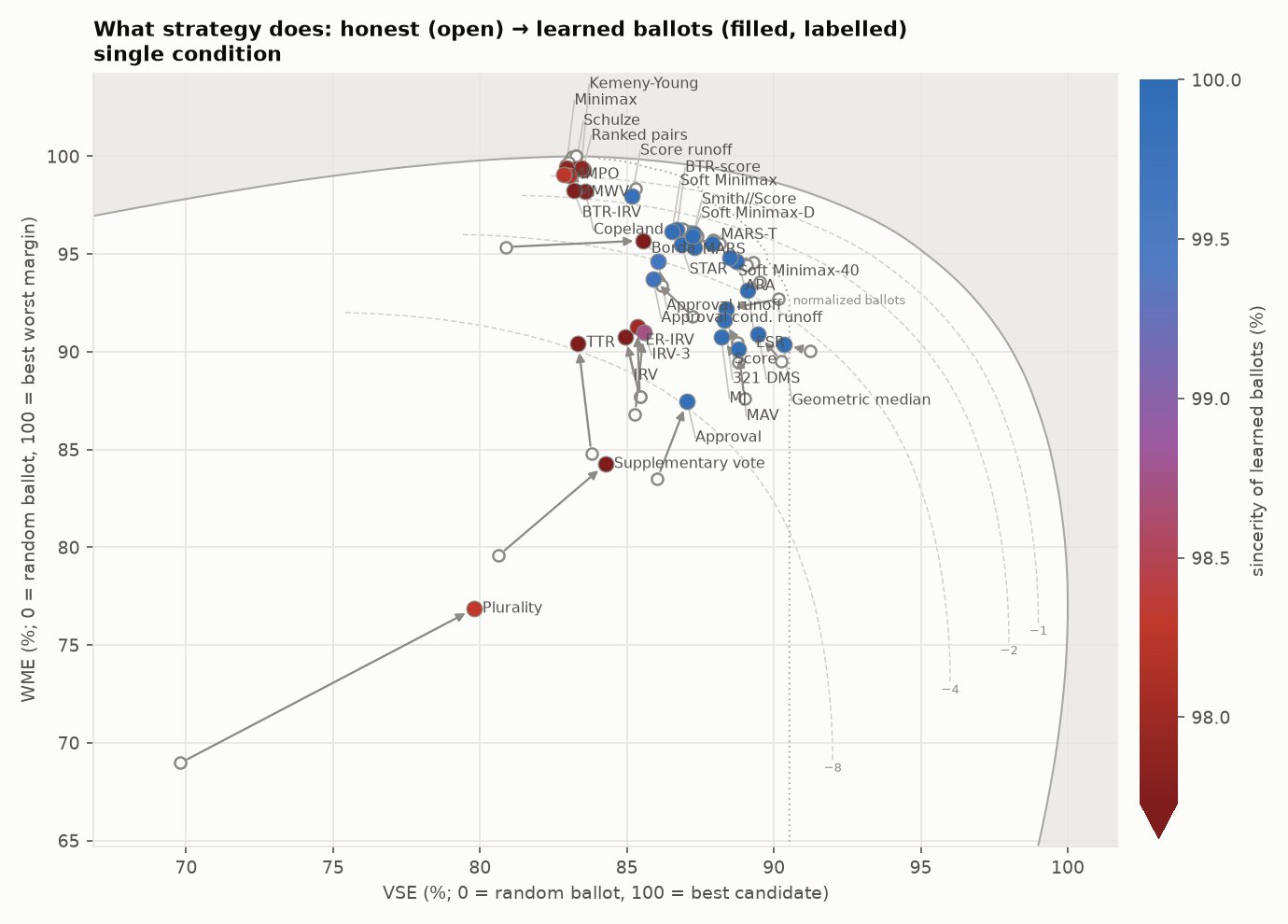
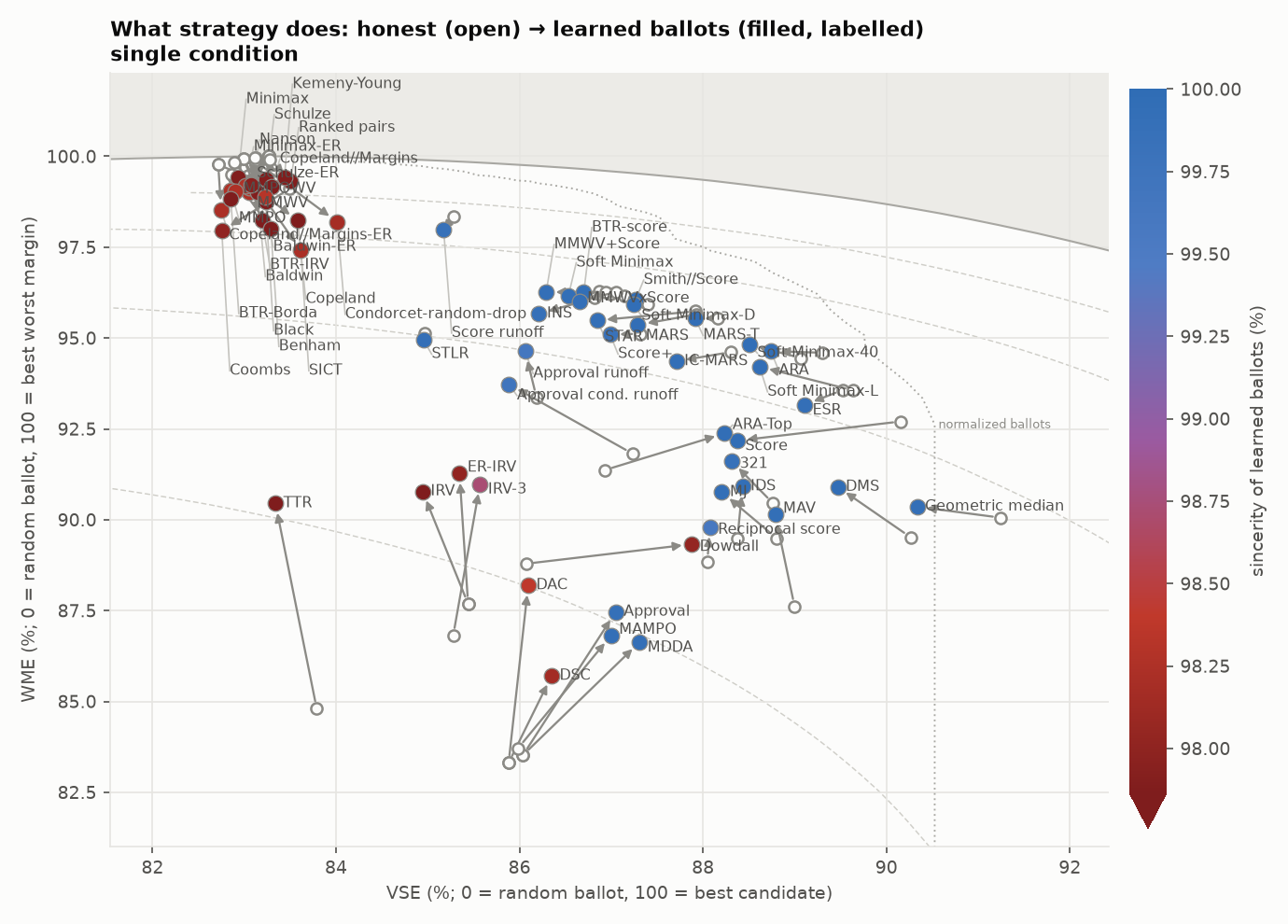
The key motivation was to have at least two dimensions to find and visualize the Pareto Front of the good voting methods. On top of that I also wanted adaptive learned strategy to not advantage or disadvantage any methods by having to fit the best strategy to the method in question (still unavoidable in the poll naive "honest" case). This has the nice side effect that one can look at which strategies emerge on their own, per method.
The result is a simple spatial voter model with learned strategy and multiple rounds of reacting to polls. There are currently 66 voting methods (one of them as an add-on, excluding tests and references), which are evaluated on the dimensions of voter satisfaction, winning margins and sincerity of ballots. Many of the variables about the model or strategy can be changed, including strategic nomination and share of strategic voters.
For the voter distribution there are several models to choose from. One using a simple fractal noise (default), one using Gaussian clusters, one using scale-free opinion fields, and Jameson Quinn's model from vse-sim (in a version with a few changes and one as in vse-sim's code).
There is an automated analysis that puts out graphs as well as a detailed report. The reports also give more information what strategies were used to what degree and similar. All in all too much information.
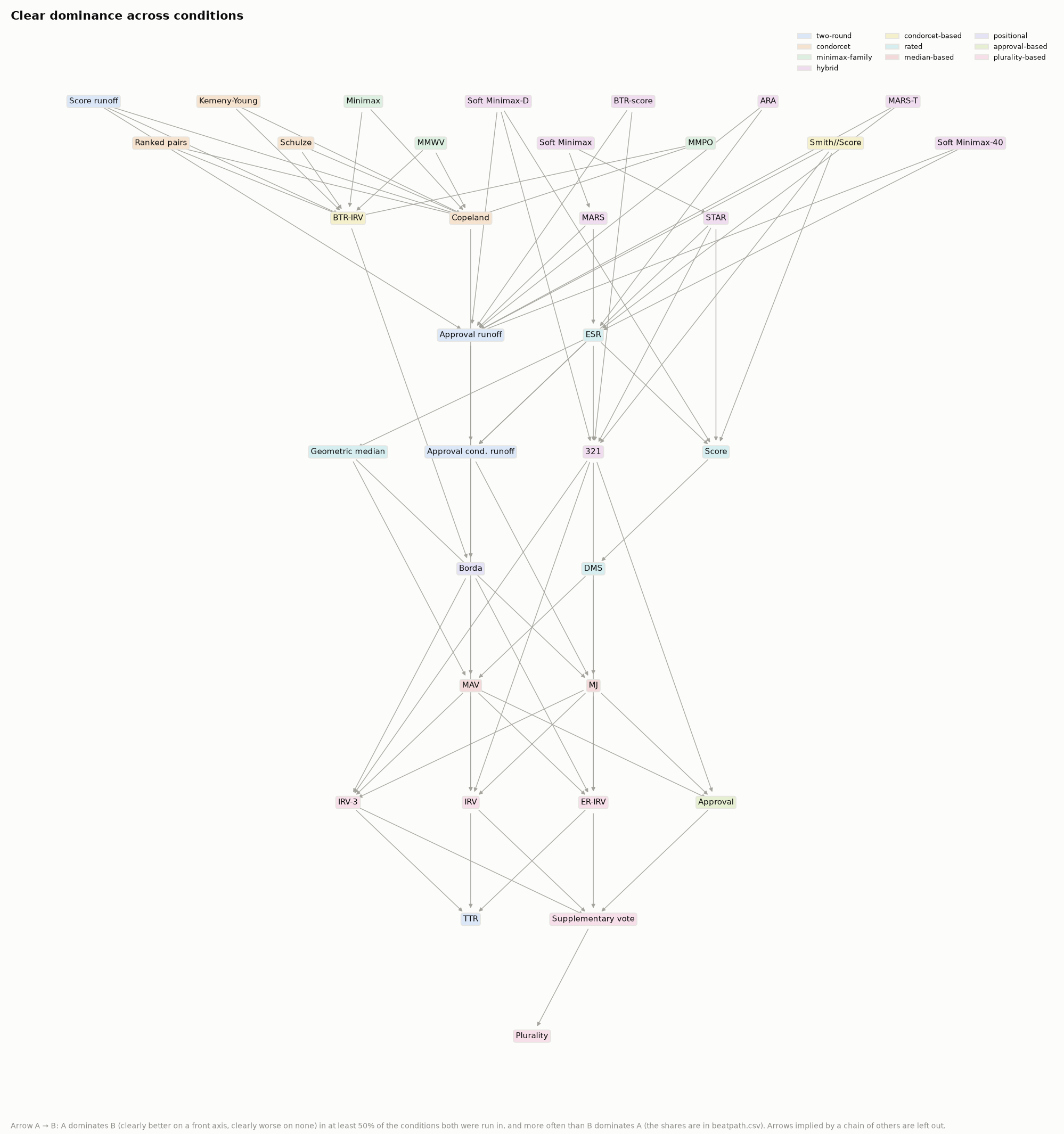
The results of several runs can be combined and compared if they use different settings, giving its own meta-report. This way one can see the effects different modeling assumptions have. It also gives a beatpath figure to illustrate which methods clearly dominate which others under several conditions.
Written in Python and with all the learning for strategy it's not very fast. A standard run with 29 voting methods 200 elections, 99 voters, 6 candidates over 3 rounds takes me under 10 minutes (time scales roughly linear when increasing these values, much faster than linear for candidates). Therefore my results have a small number of voters (99) and elections (1000 for most, 2000 for the base).
New voting methods can be added individually as addons and there is a tutorial describing how to write your own (or you can just ask an AI to do it if you don't know Python). Method definitions are short enough to share here in the comments if you like to do so. A future version might also include a simpler way to define methods, which would turn it into a one liner.
The default assumptions used diverge in several ways from prior voting simulations (for process of how these were found see the journal), but there are enough options that you can compare with other models. For example, I've run one test with settings close to vse-sim. You can try the command yourself (took me ~3h) and change settings one to see how these affect the results.
The point is not to determine the single "best" voting method. Instead it looks at three different measures. The metrics are:
You can't max all these metrics at the same time. Since Condorcet winner and utility winner can differ, there is a theoretical limit (shown as gray region in the point plots) to how good a method can perform at both.
This means that there is a tradeoff between these qualities that applies to the voting methods. Where CW and utility winner differ, electing either loses points on the other metric. The set of best methods sits on a Pareto front of these metrics.
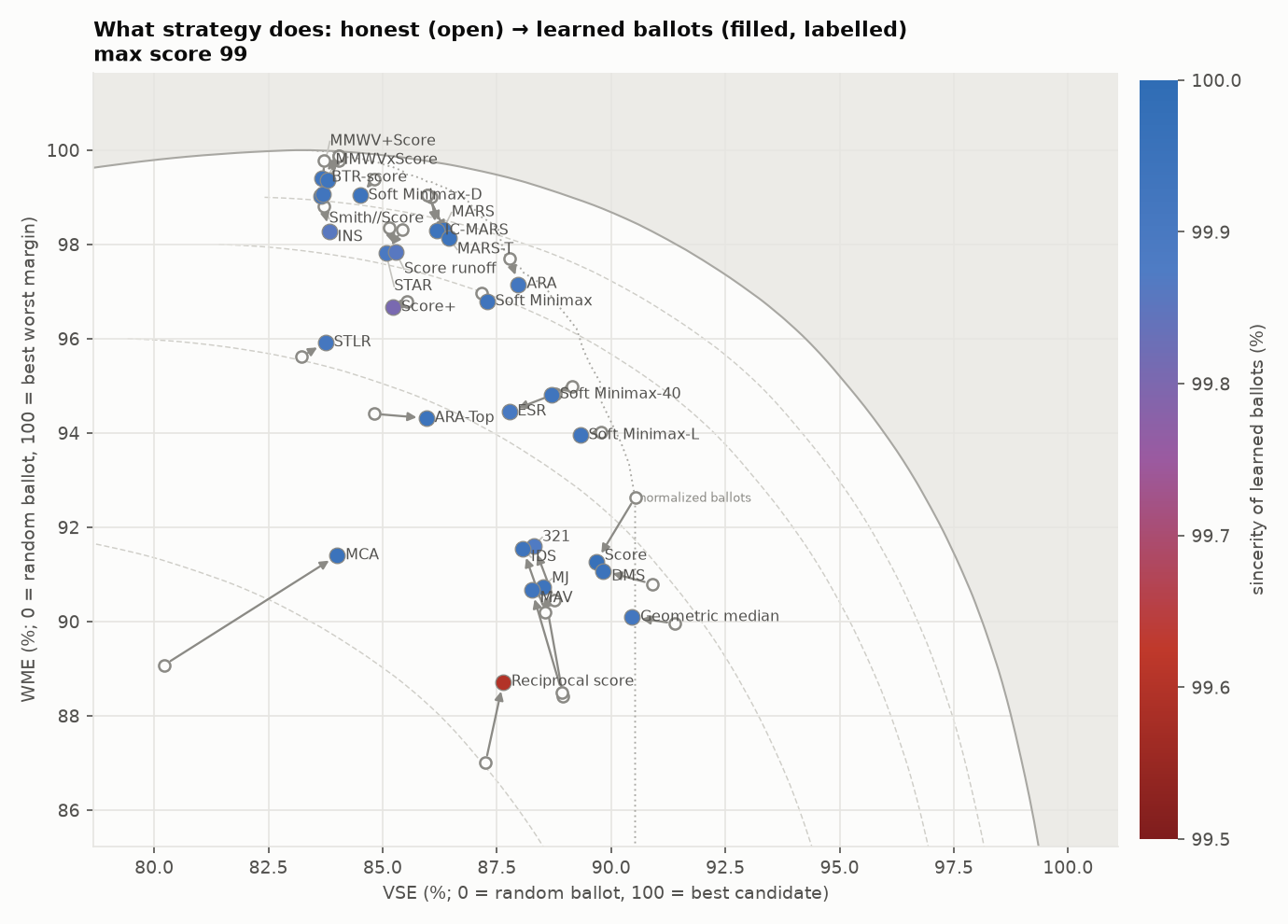
For rated ballots, it is an obvious assumption to make that voters will normalize their ballots to make use of the full range. For this those methods will fall short of reaching the ideal VSE. For this an additional dotted line labelled "normalized ballots" is shown. This is the theoretical maximum when respecting normalized ballots. The good methods are already very close to this limit as this example shows.
Deciding between these which one is "better" would require additional constraints.
Speaking of constraints; What the simulation misses completely is how complicated a given voting method is, and how practical it is to implement in the world. You could invent a method that does extremely well on all of the above metrics but still be essentially garbage, because it requires NP-hard calculation and a dense 4 hour lecture to explain how it works. As a counter example, approval voting and approval with runoff are still on my mental list of best reform options because they do well for being among the simplest methods (approval with runoff is close to the front, plain approval somewhat behind it). The problem is that I don't have an objective measure of how "simple" a voting method is yet.
There are also several other effects worth considering, such as the incentive to appeal to voters of the opposing side, but most such good qualities seem to be correlated for the most part.
1/d (Zipf's law) to model that there is a order to how relevant various issues are perceived in the public. Within this space, voters are distributed in clusters under Gaussian distribution. The first implementation was too clumpy and had large gaps between clusters. This made the electorate too hard and separated CW from the utility winner. Under analysis it turned out that the cluster approach already creates something similar to a Zipf like distribution, so adding it on top doubled it. Therefore the defaults are without the Zipf law, but it can be turned on if needed.Candidates are drawn from the same space as voters. But there are options to shift and scale the candidate distribution, to model selection bias.
However, under reasonable assumptions, the same group of methods stays on the front, though the order within it shifts.
Apart from the basic settings of numbers of voters and candidates and model parameters, there are several settings regarding strategy and voter behaviour.
There are quite a lot of methods (not all of them serious, some only as theoretical reference), but if you are missing one of your favorites, then please tell me.
The default settings and most tests include the following 29 as standard comparison: Plurality, IRV, Borda, Approval, Score, STAR, MJ, MAV, 321, Ranked pairs, Schulze, TTR, Supplementary vote, ER-IRV (equal ranked IRV), IRV-3, Approval runoff, Approval cond. runoff, Copeland, Kemeny-Young, Minimax, MMWV, MMPO, BTR-IRV, Score runoff, MARS, ARA, BTR-score, Smith//Score and Soft Minimax-D
Here is a plot with the large set, only excluding some to get a zoomed in view.
There are also some methods that have been added here that are new for the most part:
Approval cond. runoff is a test in between plain approval and approval with obligatory runoff. Here in Germany we have TTR in almost all single winner elections, and people are married to the idea that the winner has to have more than 50% of the votes, but also don't like holding two elections every time. So I wondered if Approval voting with a conditional runoff would work, to only hold a runoff if no candidate has over 50% approval. The results show it consistently performing better than plain approval as well as TTR. However, it can behave a bit strange as the threshold for the runoff can invite for strategic voting. Or at least, I haven't looked deeply enough to make conclusions.
Soft Minimax and the variant Soft Minimax-D were invented in the process of making this simulation. They are therefore fitted to the metrics rather than inspired by theory, so the results have to be taken with caution. I invited Claude to make up a voting method of its own, and it reasoned that Minimax and score are strong contenders, so a continuous interpolation should give good methods in between. This is done by a fixed cutoff in score. Votes above this cutoff are counted as votes for one candidate over the other, votes below are counted as score. This gave Soft Minimax with a 20% cutoff. I then reasoned that it might be improved by determining the cutoff per match from the difference in average score between both candidates (plus one point), which gives Soft Minimax-D, which in general does perform better.
ESR (expanded support runoff) is also a new addition that I came up with while working with these simulations. It's effectively a graded Bucklin system to serve as a filter (similar to the idea of a MAF) for a normalized score runoff. In particular, voters submit a score ballot, then one counts the scores for each level of depth, starting at the top, to see who does best on each level. I.e. on a scale 0-5, count the 5 rated first, then all 5 or 4 rated, then 5, 4, 3 and so on. The set of all candidates that perform best in this way enters the automated runoff (single member wins outright). The runoff is by normalized score (but BTR-score or MARS would also be reasonable).
DMS is a similar idea to ESR. Recording the performance of each candidate at each level of depth and then minimaxing to find the candidate who's worst performance at any level is best.
TRASH is, as the name implies, the very best... Actually, I invented it to be worse than plurality voting and it really does succeed at this task.
Since this is all fresh and there might still be some bugs or hidden false assumptions that influence the results, I don't want to look too closely at number of individual methods. But what can be observed clearly are general trends with various methods. Which make sense in hindsight.
Borda is the exception to pretty much everything I say here - it just behaves weird. And plurality is just bad in every way. The only methods worse are anti-plurality and TRASH (left out of the tests for this reason).
Condorcet methods are very robustly good under various assumptions. The supporters of the CW can almost always defend them with counter-strategy. Therefore they appear very strategic but hardly lose quality due to it.
Rated methods remain sincere. Since inversions of ranking have no use in ratings. Exaggeration does exist, but isn't as bad as one could expect. Score still scores above approval in both measures, so it doesn't fully devolve into approval voting.
Hybrid methods that combine Condorcet with ratings (Smith//Score, STAR, BTR-score, Soft Minimax-D, MARS, ARA) seem to inherit the robustness of the one and the honesty of the other. The best of both worlds, while also often performing better than a mere average between score and Condorcet would suggest.
A dedicated runoff improves methods a lot, but on the cost that a runoff has in real life (doubling the cost for the election, and often a lower turnout). Score runoff is the method that is undominated most often across all conditions. But, as one can reason, it suffers from the problem that the leading candidate can run a clone and then nullify the use of the runoff. So with strategic nomination turned on it becomes more like plain score. For a fair comparison it might be necessary to compare runoff methods in their own category.
However, this still implies that one of the simplest methods to explain is also one of the best performing. As a reform proposal this is a strong candidate. If someone then objects, for good reason, that the runoff has problems, then STAR comes to the rescue.
Since rated methods are inherently strategic, the assumptions that go into modeling the honest vote matters a lot. Strategy can repair some of it given enough time. For Condorcet methods and IRV, the honest vote is just a honest ranking. For rated, default ratings are 0 to 5. As the default runs also use 6 candidates, this means for hybrid methods means that they can't take full advantage of both the Condorcet property and score differences.
Currently it is assumed for the honest vote that voters submit a rating, normalized to min an max, instead of trying to take advantage of all ratings. These ties lose pairwise information, but are true to the utility preference. For this reason, increasing the max score makes them behave more like Condorcet methods. If one would model them to take advantage of the whole range, avoiding ties, then this would become a Condorcet-Borda hybrid, rather than score.
The reality is probably in between these two extremes, because the voters get to decide how to use their ballot. But this is why I actually do like the hybrid methods a lot. It allows for both, so voters can choose and use the strategic protection that comes from Condorcet methods when they need it.
I started making this just out of curiosity to see how various methods map onto two metrics like these. I didn't expect to find any satisfying answer. As expected there is no single best voting method dropping out of this. However a higher level insight still feels like satisfying conclusion. The dotted line labeled "normalized ballots" was added after that insight and confirmed it.
You see, while I was plotting these methods under various conditions and inventing and trying new ones, it became apparent that they were approaching a limit that is below the theoretical VSE limit, but still roughly following the shape. I wondered why the methods can hardly improve beyond the current front and the answer is actually quite simple: VSE is measured in terms of absolute utility, while the honest ballots are normalized (each voter stretches their scores to their own range).
So this is a flaw in the model, but one that can not be removed without introducing a different bias. Strategy allows voters to regain that expressiveness, as each voter has one vote. The normalized line then shows the maximum VSE a method could attain if all voters use the most basic strategy of using their full vote. But methods still can occasionally pass beyond it when the votes aren't optimized to the maximum.
All in all this means that the limit is much lower than I originally thought. And looking at it, it becomes apparent that the current best methods all lie very close to that limit. Trying to improve upon them mostly results in tradeoffs and only gains a little. And even if an improvement in both values is possible, then it comes with added complexity (see e.g. the runoff methods).
With this I realized that the best voting methods we currently have are already close to as good as it gets. We are already hitting diminishing returns on the whole front. Within this model, there is no need to find any better methods. Instead, we can just look at the front and pick those that are practical, simple to explain and implement, or have some theoretic appeal.
This means that most of the voting methods that are discussed among experts are already at the Pareto front of ideal methods (except IRV and TTR, which are just worse, Borda, which is just weird, and plain approval, which is somewhat behind but very simple). There is a clear set of good methods which lie on that front. Picking those performing better in WME or VSE, in between, or by some theoretical argument is mostly a matter of taste. Either side can look better depending on the assumptions one puts into the model. Theoretical flaws, like being susceptible to the dark horse and three rivals scenario, or the chicken dilemma, seem to not influence the results much, at least in this model. Practically, all the "good" methods seem to be about equally good and there is no risk for implementing one rather than the other, as long as we replace the clearly bad voting methods we currently use almost everywhere.
r/EndFPTP • u/theoriginalnickho • 1d ago
r/EndFPTP • u/sami_coolfun11 • 4d ago
r/EndFPTP • u/RankdHQ • 7d ago
I kept needing a quick way to count ranked ballots for small groups (clubs, friends picking a restaurant, office votes), so I built a free calculator:
https://rankd.app/tools/ranked-choice-calculator
- Paste one ballot per line, like `Tacos > Sushi > Pizza`. Add `12:` in front for 12 identical ballots.
- It shows every round: who gets eliminated, where their votes go, and how many ballots run out of choices.
- There are Borda and Condorcet versions too, so you can paste the same ballots into each and compare winners.
- It runs in your browser. No sign-up, and nothing is saved.
The example on the page is a nice demo: Tacos leads round 1 but loses under instant runoff, and Borda and Condorcet pick yet another winner.
When two options tie for last, it eliminates the one that had fewer votes in the previous round. If they were tied every round, both go. I'd love to hear if you think a different tie-break rule is fairer.
r/EndFPTP • u/mrsusandothechoosin • 8d ago
Hi all,
Nanson's and Baldwin's methods are both very easy for determining who to eliminate in AV (below average borda score and lowest borda score respectively) but I was curious what would be the natural translation to when there's more than one seat available?
Baldwin's is simple in that it's always the lowest score, but with trying to adapt Nanson's to STV (proportional representation) do you still eliminate below the average? Below 2/3rds of the average for 2 seats, and so on?
The closest solution I've come up with is eliminating (total candidates - seats)/2 candidates... But I don't know if that ruins the intent behind taking the average borda score
Eliminating and recalculating the borda score of 30 candidates one by one would be very taxing on resources, so I'm trying to find a way to do it in chunks... But there doesn't seem to be any literature on it (from what I can find)
Anyone more knowledgeable about it able to give their thoughts?
r/EndFPTP • u/Wally_Wrong • 9d ago
r/EndFPTP • u/ranked-melee • 9d ago
The Canadian province of British Columbia used Instant Runoff Voting (IRV) or ranked ballots in 1952 and 1953. I am trying to recreate that magic within the limitations of our First Past the Post system.
Our province has three major parties—the New Democratic Party (NDP), the Conservative Party, and the Green Party. The NDP and the Greens are generally considered to be progressive, while the Conservative Party is generally considered conservative.
There are multiple strategic voting websites that hope to consolidate the progressive vote, but there is a unique dimension to BC politics that this doesn't capture. Since the NDP is a 'big tent' party that attracts both centre-right and centre-left voters, and because the environmental focus of the Green Party draws supporters who are otherwise conservative or progressive, voters of each party may have either of the two other parties as their second choice.
Given these dynamics, there is probably a voter out there for each of the six possible permutations:
I created an interactive map to capture this nuance and show the best vote for each permutation in each riding. https://rankedballot.ca/
Voters can create a ranked ballot depending on their own preferences, and see what choice best avoids their lowest-ranked party. Where their lowest-ranked party isn't competitive, it shows their first-ranked party. The data source is 338 Canada, a weighted aggregator of polling data.
The actual interface changes colour based on the first-ranked party.
r/EndFPTP • u/ILikeNeurons • 10d ago
r/EndFPTP • u/Nice-Percentage9129 • 10d ago
It was first proposed almost 10 years ago and was last proposed last year's July. There needs to be more concerted awareness and promotions of this bill to grab Congress' attentions.
I'm not sure which voting systems are ideal but I'm certain FRA alone guarantees ending gerrymandering for good and make genuine multiparty governings a reality that many voting systems that are being experimented locally doesn't.
This is why focusing on passing the FRA should be a top priority above all else to finally end the fptp duopoly system regardless of localized voting systems that are being tested rn.
r/EndFPTP • u/bkelly1984 • 11d ago
Earlier this week, I claimed that STAR voters are almost always better off rating people at the extremes, 5 or 0. Sass disagreed, arguing that a voter with no insight into how everyone else will vote will do better scoring their second choice a 4, and their second-to-last choice a 1. I believe his logic is that the score gives them a boost in the runoff round.
To resolve this difference in perspective, I asked AI to write a STAR simulation that compares the expected value of rating a second choice 4 versus 5 across many random elections. I then ran a bunch of trials and thought everyone might be interested in the results.

With 3 or 4 candidates, a voter with no information does better rating their second choice a 4. With 5 candidates it’s roughly a wash, and with 6 or more, a 5 is better.
There are two reasons the strategy changes as the roster grows. First, your first and second choices become less likely to meet in the runoff, so maintaining a distinction between them matters less. Second, the competition to get into the runoff is increased, so the extra point becomes more valuable.
Simulation Notes
r/EndFPTP • u/Snoo-33445 • 12d ago
r/EndFPTP • u/JMarty97 • 12d ago
r/EndFPTP • u/sami_coolfun11 • 15d ago
Here’s an explanation of a version of STV+ known as the Ranked Ballot Remainder+ method. Please let me know your thoughts on this system!
Here’s how it works:
- 85% of MPs are elected from multi-member constituencies, each returning between 2 and 7 MPs.
- 15% of MPs are elected as regional top-up MPs.
- Each region would have approximately 19 MPs in total, including both constituency and regional representatives. This would result in a Droop quota of approximately 5% of the region-wide vote.
- Voters can choose to rank one of more parties in order of preference, and/or put an X beside the individual candidate they support from the party they ranked first. Independent candidates can run as a single-candidate list, and will have their own box on the ballot that voters can rank.
- In Canada, this system can be implemented by either merging 3-8 neighbouring ridings together, then removing one seat from each riding to serve as a regional top-up seat OR by merging neighbouring ridings to form 2-7 member ridings, while increasing the size of Parliament by only 15% to accommodate the additional regional top-up MPs.
To elect the riding MPs, here are the steps to follow:
Regional top-up seats use the same general allocation method as constituency seats, with the following modifications:
- The Droop Quota is based on the number of votes in the entire region and based on the overall number of seats in the entire region (riding + regional top-up)
- Regional top-up seats are allocated to unelected candidates based on their party’s performance in each constituency. For each party, the candidate with the most individual votes in a constituency is eligible for a top-up seat, with only one candidate eligible per constituency. Candidates are prioritized according to the percentage of the local vote their party received, with the party’s strongest-performing constituencies prioritized first.
- If a party or independent candidate wins more constituency seats than their regional seat quota entitles them to, recalculate the regional top-up allocation. Remove all of the votes associated with the overrepresented party or independent candidate and reduce the Droop quota calculation to account for the constituency seats already won by that party or independent candidate
What happens if a party has ran too few candidates in their riding or region:
A party may receive enough votes to qualify for more seats than the number of candidates it has nominated in a constituency or region. The following rules apply.
- If a party’s seat quota exceeds the number of candidates it has nominated, its fractional remainder is calculated by subtracting the number of candidates it ran from its seat quota. For example, if a party has a seat quota of 1.73 but nominated only one candidate, its remainder would be 0.73 (1.73 − 1.00 = 0.73).
- If one or more parties have a projected seat entitlement greater than the number of candidates they nominated, their remainders are transferred first. These parties become ineligible to receive any of the remaining seats in that constituency or region, as they do not have enough candidates to fill them.
r/EndFPTP • u/cshivers • 17d ago