r/PoliticalPhilosophy • • Feb 06 '20

Welcome to /r/PoliticalPhilosophy! Please Read before posting.

54 Upvotes

Lately we've had an influx of posts that aren't directly focused on political philosophy. Political philosophy is a massively broad topic, however, and just about any topic could potentially make a good post. Before deciding to post, please read through the basics.

What is Political Philosophy?

To put it simply, political philosophy is the philosophy of politics and human nature. This is a broad topic, leading to questions about such subjects as ethics, free will, existentialism, and current events. Most political philosophy involves the discussion of political theories/theorists, such as Aristotle, Hobbes, or Rousseau (amongst a million others).

Can anyone post here?

Yes! Even if you have limited experience with political philosophy as a discipline, we still absolutely encourage you to join the conversation. You're allowed to post here with any political leaning. This is a safe place to discuss liberalism, conservatism, libertarianism, etc. With that said, posts and comments that are racist, homophobic, antisemitic, or bigoted will be removed. This does not mean you can't discuss these topics-- it just means we expect discourse to be respectful. On top of this, we expect you to not make accusations of political allegiance. Statements such as "typical liberal", "nazi", "wow you must be a Trumper," etc, are detrimental to good conversation.

What isn't a good fit for this sub

Questions such as;

"Why are you voting Democrat/Republican?"

"Is it wrong to be white?"

"This is why I believe ______"

How these questions can be reframed into a philosophic question

As stated above, in political philosophy most topics are fair game provided you frame them correctly. Looking at the above questions, here's some alternatives to consider before posting, including an explanation as to why it's improved;

"Does liberalism/conservatism accomplish ____ objective?"

Why: A question like this, particularly if it references a work that the readers can engage with provides an answerable question that isn't based on pure anecdotal evidence.

"What are the implications of white supremacy in a political hierarchy?" OR "What would _____ have thought about racial tensions in ______ country?"

Why: This comes on two fronts. It drops the loaded, antagonizing question that references a slogan designed to trigger outrage, and approaches an observable problem. 'Institutional white supremacy' and 'racial tensions' are both observable. With the second prompt, it lends itself to a discussion that's based in political philosophy as a discipline.

"After reading Hobbes argument on the state of nature, I have changed my belief that Rousseau's state of nature is better." OR "After reading Nietzsche's critique of liberalism, I have been questioning X, Y, and Z. What are your thoughts on this?"

Why: This subreddit isn't just about blurbing out your political beliefs to get feedback on how unique you are. Ideally, it's a place where users can discuss different political theories and philosophies. In order to have a good discussion, common ground is important. This can include references a book other users might be familiar with, an established theory others find interesting, or a specific narrative that others find familiar. If your question is focused solely on asking others to judge your belief's, it more than likely won't make a compelling topic.

If you have any questions or thoughts, feel free to leave a comment below or send a message to modmail. Also, please make yourself familiar with the community guidelines before posting.

r/PoliticalPhilosophy • • Feb 10 '25

Revisiting the question: "What is political philosophy" in 2025

21 Upvotes

Χαῖρε φιλόσοφος,

There has been a huge uptick in American political posts lately. This in itself is not necessarily a bad thing-- there is currently a lot of room for the examination of concepts like democracy, fascism, oligarchy, moral decline, liberalism, and classical conservatism etc. However, posts need to focus on political philosophy or political theory. I want to take a moment to remind our polity what that means.

First and foremost, this subreddit exists to examine political frameworks and human nature. While it is tempting to be riled up by present circumstances, it is our job to examine dispassionately, and through the lens of past thinkers and historical circumstances. There are plenty of political subreddits designed to vent and argue about the state of the world. This is a respite from that.

To keep conversations fluid and interesting, I have been removing posts that are specifically aimed at soapboxing on the current state of politics when they are devoid of a theoretical undertone. To give an example;

  • A bad post: "Elon Musk is destroying America"
  • WHY: The goal of this post is to discuss a political agenda, and not examine the framework around it.

  • A better post: "Elon Musk, and how unelected officials are destroying democracy"

  • WHY: This is better, and with a sound argument could be an interesting read. On the surface, it is still is designed to politically agitate as much as it exists to make a cohesive argument.

  • A good post: "Oligarchy making in historic republics and it's comparison to the present"

  • WHY: We are now taking our topic and comparing it to past political thought, opening the rhetoric to other opinions, and creating a space where we can discuss and argue positions.

Another point I want to make clear, is that there is ample room to make conservative arguments as well as traditionally liberal ones. As long as your point is intelligent, cohesive, and well structured, it has a home here. A traditionally conservative argument could be in favor of smaller government, or states rights (all with proper citations of course). What it shouldn't be is ranting about your thoughts on the southern border. If you are able to defend it, your opinion is yours to share here.

As always, I am open to suggestions and challenges. Feel free to comment below with any additional insights.


r/PoliticalPhilosophy • • 3h ago

Can a Party like the Students-List in Serbia survive in the long run?

2 Upvotes

The "Party" (not sure about the political correctness here since it’s a "just" a List) established itself mainly as an anti-corruption movement, but I can’t imagine that all their members share the same opinion on certain topics (for example in the discussion around the independency of Kosovo, or "simpler" stuff like economics, foreign affairs,…), which they will have to deal with sooner or later.

Am I wrong for thinking that their party/list will shatter into many smaller parties until there is nothing left of it?

Theoretically it’s not a bad thing, but there’s this risk that old SNS voters go back to SNS since they may feel like the students party is too instable and paralyzed in their decision making since their opinions vary too much.


r/PoliticalPhilosophy • • 21h ago

What to Know About the Israeli Elections

3 Upvotes

My friend Ran Heilbrunn wrote this for Café Américain, the first part of a four-part series on contemporary Israel. The theory claim I found most interesting: in Israel and in many other democracies, the constitutional and institutional order is turning into the thing elections are fought over, rather than the framework they happen inside. He argues that treating every election as a vote on democracy itself is undemocratic, and that the 2022–2026 government served its full term because so much of the public sees it as illegitimate, so that "a lack of popular support has paradoxically produced electoral stability." The link goes to Café Américain's post on X, which links to the article; if you think it's worth it, a repost or reply there is welcome. I'd also like to hear here whether you think a legitimacy deficit producing stability is a general pattern or something specific to Israel.

https://cafeamericainmag.com/what-to-know-about-the-israeli-elections/


r/PoliticalPhilosophy • • 1d ago

Is there a stable 'safe zone' between state capacity and executive constraint, or are all governance systems inherently unstable?

1 Upvotes

A government faces a recurring dilemma. If it tightens restriction to secure order, it raises the probability that grievance, elite defection, digital coordination, and external sponsorship will produce rebellion—or a punitive successor regime. If it loosens restriction to preserve liberty, it raises the probability that insecurity, polarization, corruption, and organized capture will generate public demand for a strongman—or allow a faction to seize the state.

This is not a simple tradeoff between order and liberty, because citizens’ preferences are partly endogenous: fear can be manufactured, trust depleted, and emergency powers ratcheted. State capacity is asymmetric: coercion and surveillance are easier to build than impartial justice and accountable security. Crises reward speed over consent and create path dependence. Elites and security forces can defect under either course. Information abundance empowers demagogues and foreign manipulation; information control hides corruption and radicalizes excluded groups. Liberalizing too fast invites capture; liberalizing too slowly invites revolt. The “safe zone,” if it exists, is not a fixed midpoint but a moving corridor sustained by legitimacy, capacity, credible constraints, and sequencing.

The dilemma’s core is a pair of feedback loops. The repression loop runs: insecurity → demand for control → surveillance and restriction → grievance, elite defection, and coordination → more insecurity → more control. The liberalization loop runs: opening → insecurity and polarization → demand for a strongman or factional capture → illiberal correction. Each loop can become self-reinforcing, and the tools used to stabilize one failure mode can create the other.

The moral question is therefore not whether to choose order or liberty, but how a government can build enough capacity to protect citizens, enough constraint to prevent tyranny, enough openness to correct error, and enough sequencing to survive crises—without letting the instruments of stabilization become either a repression ratchet or a gateway to authoritarian capture. The difficulty is that these goods are mutually dependent yet asymmetrically costly: capacity without constraint becomes predation; constraint without capacity becomes paralysis; openness without sequencing becomes capture; sequencing without openness becomes irreversible emergency.

So here’s my question: How do governments balance state power and individual freedom without spiraling into either tyranny or chaos, and is it even possible to maintain that balance over time?


r/PoliticalPhilosophy • • 1d ago

Bissmilah c'est les Ténébres: an article I wrote on historical resonances to the present moment.

3 Upvotes

History is rhyming. The fear of "the other" in the West right now is a symptom of a collapsing cultural hegemon (Pax Americana) facing the exact same climate and systemic fractures as the Bronze Age Collapse and the Third Century Crisis of Rome. The French police trying to infiltrate protests with the phrase "Bissmilah c'est les Ténébres" proves how out of touch the empire is. We are the privileged youth finally seeing the suffering our lifestyle causes. We must stop asking "how do I protect my comfort?" and start asking "how do we build a society of care where no one suffers to the point of destabilizing others?"

My article on the topic: https://aidennettavong.substack.com/p/bissmilah-cest-les-tenebres?r=2xkfc4&utm_campaign=post&utm_medium=web&showWelcomeOnShare=true


r/PoliticalPhilosophy • • 1d ago

Ideology sorting

1 Upvotes

Hey everyone! I found an interesting website that classifies political ideologies according to traditional political philosophy labels, and thought I’d share it here for you guys to look at: Political Spectrum Matrix


r/PoliticalPhilosophy • • 2d ago

Edmund Burke wasn’t inherently conservative

0 Upvotes

His appeal to tradition and established institutions constitutes proposed brakes that serve to prevent (r)evolutions from becoming hijacked by the whims of the few.

I understand Burke’s critique of the events of the French Revolution not as a refutation of progress but as an alternative philosophy of progress, and a superior one at that.

I don't believe this is a particularly outlandish claim to make, but it tends to land weird in conservative circles and I don't really understand why that is.


r/PoliticalPhilosophy • • 3d ago

Favorite or best French Political philosopher.

Thumbnail
1 Upvotes

r/PoliticalPhilosophy • • 3d ago

Spinoza and Nietzsche's to Tocqueville's democract critique.

Thumbnail
2 Upvotes

r/PoliticalPhilosophy • • 3d ago

When would you finally say enough is enough

1 Upvotes

What would have to be revealed about the world for you to feel compelled to rise up and fight for change ? Not poverty, hunger or the deprivation of basic human needs, but a fundamental truth about humanity, society or the people in power - something so disturbing that remaining passive would become unbarable. What could that truth be ? Share some comments down below.


r/PoliticalPhilosophy • • 3d ago

Political vs. Politics

1 Upvotes

I am not, by any means, an expert regarding political topics, so I wanted to get your opinions on the following thoughts I have had as of late:

Do you think that one could think about 'the political' and 'politics' as two different concepts?

If so, what would you consider are the characteristics that set them apart? (Ontological, practical, etc.)

I wonder about it, for a friend of mine has repeatedly stated that 'everything is political', which is something common to say. However, I do not think I fully understand the statement.

Would that mean that everything is at the core in ontological terms a domain of politics? Or that being 'political' is an inherent ontological characteristic of all entities?

Does it mean that everything is susceptible to a political analysis or alike?

I'm eager to read your takes! Thanks!


r/PoliticalPhilosophy • • 3d ago

Tell me this is not what was meant in this song

0 Upvotes

Clowns to the left of me, jokers to the right. Here I am stuck in the middle with you.


r/PoliticalPhilosophy • • 4d ago

Is it a paradox that warfare entertainment could both reflect the absence of global peace and potentially help us achieve it?

Thumbnail
0 Upvotes

r/PoliticalPhilosophy • • 4d ago

CMV: the Non-Aggression Principle seems like a nearly strictly good thing to me.

Thumbnail
0 Upvotes

Might as well share this here I guess.


r/PoliticalPhilosophy • • 4d ago

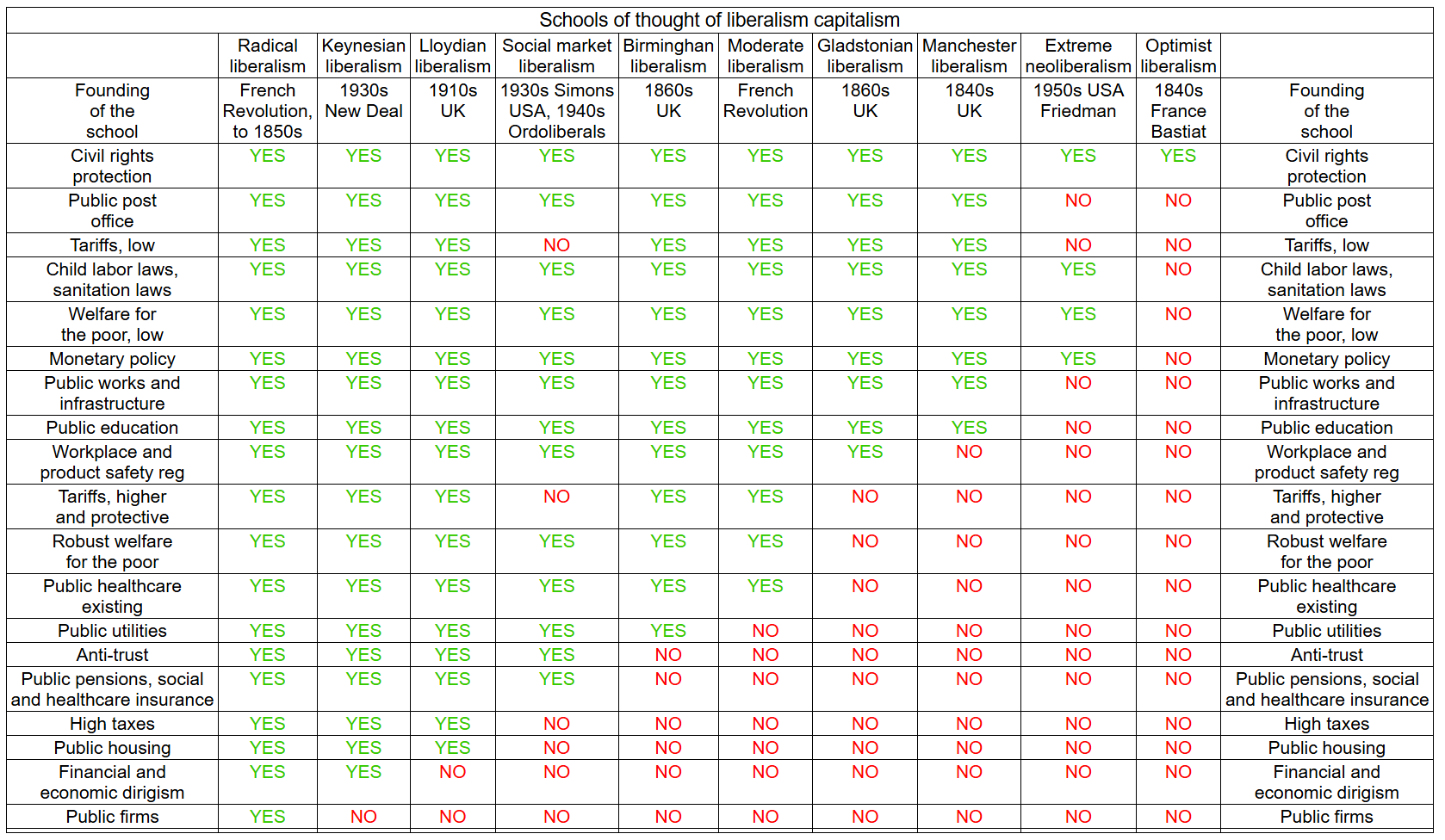
I made a table chart of different types of liberal capitalism

3 Upvotes

I made a table chart of different types of liberalism, as they developed historically, focusing on their economic views.

https://i.ibb.co/Tz3xD7s/libcap.png

Which school describes your views the closest?

What do you think about the chart?


r/PoliticalPhilosophy • • 4d ago

Values

Thumbnail
0 Upvotes

r/PoliticalPhilosophy • • 5d ago

How seriously do y'all take Plato's Republic, as one of the oldest political philosophy reflections?

10 Upvotes

Just curious, since besides Plato, I wouldn't say I'm very knowledgeable on politics


r/PoliticalPhilosophy • • 5d ago

What and how is mind nowadays?

Thumbnail
1 Upvotes

r/PoliticalPhilosophy • • 5d ago

New Age politics

Thumbnail
0 Upvotes

‘President of Sym’s Nation’
( How to learn the game of politics)


r/PoliticalPhilosophy • • 6d ago

Can a nation inherit the consequences of its past without inheriting the guilt?

2 Upvotes

I’ve been thinking about the relationship between historical power, justice, and collective responsibility.
France’s colonial history raises an interesting philosophical question.

A nation can exercise enormous power over other societies, eventually lose that power, and still experience the consequences of relationships established generations earlier.

But does inheriting those consequences imply inheriting responsibility?

There’s a verse in the Quran (3:140) that says:
“And these days [of varying conditions] We alternate among the people.”

I find this interesting not as proof of divine punishment, but as a philosophical reflection on the temporary nature of power.

Empires rise and fall. Political systems disappear. Yet the economic structures, migration patterns, cultural identities, and inequalities created by earlier systems can survive for generations.

My initial thought is that historical consequences and moral guilt are fundamentally different things.
A society might inherit circumstances created by its ancestors without its current population being personally guilty of their actions.

This raises several questions about political justice.
If a nation benefits from historical domination, does it inherit a moral obligation to address the resulting inequalities?

Can we meaningfully describe historical consequences as a form of justice, or does justice necessarily require conscious moral agency?

And perhaps most importantly:

Is history simply a continuous chain of causes and consequences, or do we impose moral meaning on those events because we want history to make sense?

I’m interested in exploring this distinction through political philosophy rather than treating history as evidence of predetermined punishment.


r/PoliticalPhilosophy • • 5d ago

New Age politics

Thumbnail
0 Upvotes

‘President of Sym’s Nation’
( How to learn the game of politics)


r/PoliticalPhilosophy • • 6d ago

I don't know what I believe anymore — help me figure out which faction I belong to

Thumbnail
0 Upvotes

r/PoliticalPhilosophy • • 6d ago

Does democratic legitimacy extend to decisions imposed on people outside the electorate?

2 Upvotes

Suppose a democratically elected government adopts a security policy that protects its citizens but foreseeably threatens access to basic necessities in another country. The people affected abroad can't vote in its elections or hold its officials accountable.

Assume the policy serves a legitimate defensive purpose and the government follows its domestic democratic procedures. The question is whether that authorization is enough to justify imposing the burdens on outsiders.

One answer starts from political membership. Governments have special obligations to their citizens, and democracy lets those citizens authorize and constrain public power. Foreign consequences don't automatically give everyone affected a right to participate. Almost any significant policy reaches beyond a country's borders, so tying participation to any effect would leave the electorate without a workable boundary.

That defense looks incomplete when basic interests are at stake. A procedure can give citizens an equal voice while leaving outsiders exposed to serious harm. Domestic authorization establishes who approved a decision. It doesn't, by itself, establish what they were entitled to authorize.

A right to vote is different from a right to justification. People abroad may lack a claim to membership in the electorate and still be owed reasons that take their interests seriously, consideration of less harmful alternatives and some way to challenge disproportionate burdens. Those requirements would constrain a government's choices without giving every affected person a veto.

Being affected by a policy is also different from being subject to a state's authority. A rise in import prices isn't the same as a blockade enforced against a country's shipping. Both can harm people, but the second is a direct exercise of coercive power, and a claim to political inclusion may be stronger there.

Equal concern needn't mean identical political rights, and special duties to citizens can't settle every conflict in their favor. The hard part is working out what follows from each relationship.

Under what conditions should serious burdens on outsiders limit what a domestic majority may legitimately authorize? And when would justification and protection be insufficient without some form of political representation?


r/PoliticalPhilosophy • • 6d ago

What comes after "Late Stage" Capitalism?

Thumbnail
2 Upvotes