When I was seven years old, my family was forced to flee escalating violence. We left Bakur – a Kurdish region in what is currently southeastern Turkey – for a city further west, where we worked in Turkish fields, living in a tent until we could save up to rent a house on the city margins, in a neighbourhood with no electricity or road access. Those are some of my earliest memories of everyday violence against people like me.
For centuries, my ancestors had lived in relative harmony with other communities. But, with the emergence of modern nation-states in the region, Kurdistan – the traditional homeland of the Kurds – was fractured into southeastern Turkey, northern Iraq, northwestern Iran, and northeastern Syria. A violent assimilation was imposed upon us. For more than a century, Kurdish people have been denied recognition as a nation, their language banned, erased from maps, stripped of citizenship rights, and dispossessed of their lands. For my generation, therefore, freedom was never an abstract political matter; armed struggle was often seen as a necessity to achieve it. Even so, national liberation movements always sought dialogue with the states they fought against. I grew up inside that insistence, carrying the hope of a dignified peace.
In 2013, after almost three decades of war, peace talks were held between the Turkish state and the Kurdistan Workers’ Party (PKK), which first sought an independent Kurdish state and, later, autonomy and increased political and cultural rights for Kurds within Turkey. In 2015, these collapsed. War returned to Kurdistan and, with it, the persecution of everyone who had staked something on that possibility of peace. This included me. I was a doctoral student at the time, researching economic autonomy in Kurdistan, and it became clear that this work would no longer be tenable in the new political climate. I moved to Latin America, to complete my doctoral studies and study revolutionary movements in that part of the world, grappling all the while with a question that had become inseparable from my own existence: how could peace be built in Kurdistan?
The academic literature on peace told me I might find an answer in Guatemala. Between 1960 and 1996, civil war had ravaged the country, killing more than 200,000 people and displacing more than a million – more than a 10th of the total population. The conflict – which began as an uprising against extreme inequality, particularly in land ownership, and systemic discrimination against the Maya people – had turned the state into a counterinsurgency apparatus, powered by paramilitary death squads and a doctrine of the ‘internal enemy’ that erased the line between combatant and civilian. Against this backdrop, the Acuerdo de Paz Firme y Duradera (Agreement on a Firm and Lasting Peace) was both celebrated and touted as innovative when it was signed in 1996. The agreement broke ground by confronting the past directly: the Commission for Historical Clarification investigated the atrocities committed during the civil war, most of them attributable to the state, and, unusually, partly as a result of its findings, heads of state were later tried for war crimes.
But it was soon apparent that the peace accord had failed to address the problems that led to the conflict in the first place. The guerilla fighters who returned to their villages – or who had to reinvent themselves in cities where no one was waiting for them – found intact the system they had been unable to transform through armed struggle: poverty. Today, Guatemala remains one of the most unequal countries in Latin America vis-à-vis class, ethnicity and gender. The deepest wound of the war – land tenure – was never resolved: no equitable land redistribution took place after the 1996 accords. In fact, as the World Bank researchers Caroline Moser and Cathy McIlwaine have noted: ‘Guatemala has become a substantially more violent country since the end of the internal armed conflict.’
One ex-combatant had joined the insurgency as a 13-year-old and stayed in the mountains until the peace accord was signed. I met him in 2017, more than 20 years after the formal end to the war, at the community radio project he had built near Xela, in the western highlands of Guatemala. ‘Despite the deaths and the hardship of the war, I never cried,’ he told me. ‘But the day the war ended, I cried – because I didn’t know how to live in peace: I had no home, no job, no trade. And I asked myself: what now?’
Peace, as currently practised, doesn’t break the cycle of injustice that leads to war in the first place
I had come to Guatemala searching for an answer to my own political and existential preoccupations but it was the ex-combatant’s question – What now? – that stayed with me, an accusation directed at the very concept of peace he had been promised.
Guatemala is not an anomaly in this regard. Since the end of the Cold War, more than 30 comprehensive peace agreements have been signed around the world but few, if any, have succeeded in building a durable peace. Accords signed under the dominant peacebuilding paradigm focus almost exclusively on stopping direct violence through ceasefires, weapons handovers, disarmament, individual reintegration, all on the assumption that democratic institutions and free markets will naturally produce lasting peace. But peace, as currently practised, doesn’t break the cycle of injustice that leads to war in the first place.
The sociologist Johan Galtung, often described as the founder of peace and conflict studies, distinguished between ‘negative peace’ – the absence of direct violence – and ‘positive peace’, which requires dismantling the structures of injustice that fuel conflict. The typical approach to peace in post-conflict contexts is encapsulated in the United Nations’ classic disarmament, demobilisation and reintegration model, first implemented by its peacekeeping operations in El Salvador in 1989 and used in more than 30 countries since. Under this strategy, former combatants are required to surrender their weapons and disband their command structures, and are entitled to short-term stipends and training that will facilitate their reintegration into civilian economic life. This approach was also implemented in Guatemala.
But what neither Galtung nor other sophisticated theorists of a liberal framework for peace tend to question is whether capitalist relations of production can lead to peace when this is itself a structural source of violence. They propose reforms, redistribution, greater inclusion – but all within the same system that armed struggles in places like Guatemala sought to transform. As a sociologist interested in revolutionary social movements, what I have observed in my fieldwork in Guatemala, Colombia and northern Syria has led me to a more radical conclusion: real peace requires building economies that operate on an entirely different logic from that of capital – not just in postwar communities but more widely, because we all need more peace in our daily lives.
Cooperatives are one mechanism through which a different economic logic, one more conducive to a durable peace, can take root.In the language of the International Cooperative Alliance – an association established in 1895 when the concept, while as old as time itself, seemed to be gaining traction in Europe – cooperatives are collective entities established by people who come together to address common economic and social needs. They are founded on principles of democracy and autonomy, and built on voluntary participation and solidarity. From the Rochdale weavers of northern England in 1844 – often regarded as the forebears of modern cooperatives – to present-day credit unions, the cooperative movement has produced both genuinely emancipatory experiments and organisations that simply reproduce market logic under a different name. Cooperativism is also central to democratic confederalism, a political theory put forth by Abdullah Öcalan, one of the PKK’s founding members. It was through reading Öcalan that I became interested in the emancipatory potential of cooperatives.
A form of self-determination oriented towards the autonomy of all peoples, particularly women, democratic confederalism proposes a structure of governance organised from the bottom up. In Öcalan’s paradigm, cooperatives are the means through which an economy in service of these principles – communal, ecological, feminist – might be built. The cooperatives that interest me, therefore, have three defining characteristics: they are part of broader social movements and territorial struggles; they prioritise meeting collective needs over the accumulation of capital; and they challenge not just economic exploitation but also the patriarchy, racism, colonialism and statism entwined with capitalism. Such cooperatives are the building blocks of what I call an ‘anticapitalist peace’ – a peace not satisfied with the silencing of arms, nor with positive peace that doesn’t challenge capitalist logic, but one that transforms the economic relations at the root of violence. I have encountered two cases that demonstrate this concretely, in two different parts of the world.
In 2014, as Syria was disintegrating under the weight of a brutal civil war, something unusual happened in the country’s north and east. The Kurdish people – after a century of systemic oppression – declared de facto democratic autonomy in the territories they began to control. Instead of declaring a new nation-state, however, they set up a system of assemblies, communes, cantons and cooperatives that sought to reorganise social life from below, under principles of democratic confederalism. This project was formalised as the Democratic Autonomous Administration of North and East Syria, better known as Rojava.
Everyone debated and made decisions about their neighbourhood, their communities, their families
By the time I arrived in early 2018, the project’s economic architecture – in service of a social economy that prioritised social, ecological and collective goals over profit maximisation – was already in place. I’d come to Rojava for doctoral research but also because it was the first time Kurds were putting democratic confederalism into practice and building cooperatives as part of a revolutionary movement. I wanted to witness that process myself, and to tell the world that an anticapitalist economy was possible. By then, half a million hectares of land had been communalised with collective-use rights, and cooperatives had sprung up in every town. Women’s economic committees are central to Öcalan’s argument that a communal economy should be guided by knowledge preserved by women over the course of capitalism’s development and spread, precisely because women think (or have typically had to think) about collective need and care. They were introducing the model to their communities with the slogan ‘one cooperative for every commune’.
Upon my arrival, what I found most immediately striking was not the scale of the project but the transformation of everyday time. In Rojava, people typically work until 2.30 pm, return home to eat and rest, then go out again at 5 pm – not to work more hours, but to take part in an assembly: of the cooperative, the commune, the women’s congress or the municipality, where everyone debated and made decisions about their neighbourhood, their communities, their families. Almost no one chose to stay at home. This organisation of time was a radical departure from the exhaustion that capitalism imposes seemingly everywhere else, where punishing schedules and precarity systematically prevent people from having any say over their own lives, leaving the state or the market as the only actor capable of making decisions about the collective.
Karl Marx called it alienated labour: work that doesn’t express human capacities but instead exhausts them, that turns both body and time into commodities. This form of violence produces no visible corpses, no headlines, but something essential is destroyed all the same: the possibility of deciding over one’s own life. What do I produce? For whom?How do I want to live? Under capitalism, such questions are answered not by people but by the market. In Rojava, people sought to answer these questions collectively – What do we produce? For whom do we produce? How do we produce? – in assemblies and other public fora, and established cooperatives accordingly.
In the commune assemblies that I attended, people deliberated these questions in relation to electricity, grain and bread. Answering ‘How many loaves will we produce?’ required knowing how many families ate bread and how much bread they typically consumed. But ‘How will we produce it?’ demanded something else entirely: the founding of a bread cooperative that reversed a belief – ‘We are a society that no longer knows how to make bread’ – born of what many considered the Syrian state’s colonial-era ‘prohibition’ on baking one’s own bread. Strictly speaking, no formal prohibition existed; rather, state subsidy programmes and a ration-card system for wheat and flour made people dependent on cheap, state-distributed bread, which undermined the practice of baking at home. To want to return to older methods was to have to relearn them, to recover knowledge that had often been taken away deliberately.
Then there was the question of milk, from a cooperative built to raise animals: should it go to the children first, to the neighbours, or should it become the basis of a yogurt factory? Answers to each had to be found. In other words, as communes debated how to produce to meet their needs, they were never simply weighing inputs against outputs; they were reaching for an economy grounded in anticolonial practice and in an ethical distribution of the surplus. Everyone who lived in the commune took part in these debates – the differences of political opinion, religious belief and ethnic identity that had been named as causes of Syria’s civil war were not, here, a source of conflict or division. They became, instead, the commune’s social wealth, raw material from which richer, more varied answers and solutions could be found.
Equally central to the project was its feminist dimension. Rojava’s social economy is based on a principle that mainstream economics – and most Left movements – have historically ignored: reproductive and care work, performed predominantly by women, is not a secondary complement to the economy, but its foundation. When that work remains invisible and confined to the domestic sphere, women cannot partake in political life and are unable to participate in the assemblies that build autonomy. Rojava’s social economy promoted the socialisation of such work through cooperatives where women could participate without commodifying their labour. Across Kurdistan, for instance, women have always prepared preserves for the turn of the seasons: cheeses, pickled vegetables, dried produce, ground spices. Done alone, for one’s own family, this work was never counted as economic activity, even though it catered to a large share of collective need. These preserves aren’t just food, either: they carry memory, culture, the rhythm of the land’s cycles. The cooperatives built around them safeguard that inherited knowledge and turn it into a shared capacity, allowing women to produce for their families and communities, and exchange or sell the surplus to meet other needs.
I found this to be deeply intuitive: if the organisation of the economy is itself the organisation of life, then transforming the economy ceases to be a distant or abstract struggle, instead becoming a concrete way of inhabiting the world daily. This socialisation is not incidental or complementary to peace; it is a structural condition of peace.
Political autonomy is destroyed by military force; cultural identity is granted as a gesture of tolerance
What I witnessed in Rojava was something I had rarely seen in post-conflict contexts: peace built not as the absence of war – because war continues in Rojava – but as a way of daily life. Historically, millions of people were living a process of true self-governance, with their identities reconstituted and their voices active in collective decision-making. To build anticapitalist peace, Rojava shows, negative peace is not indispensable. The form of social organisation is what matters.
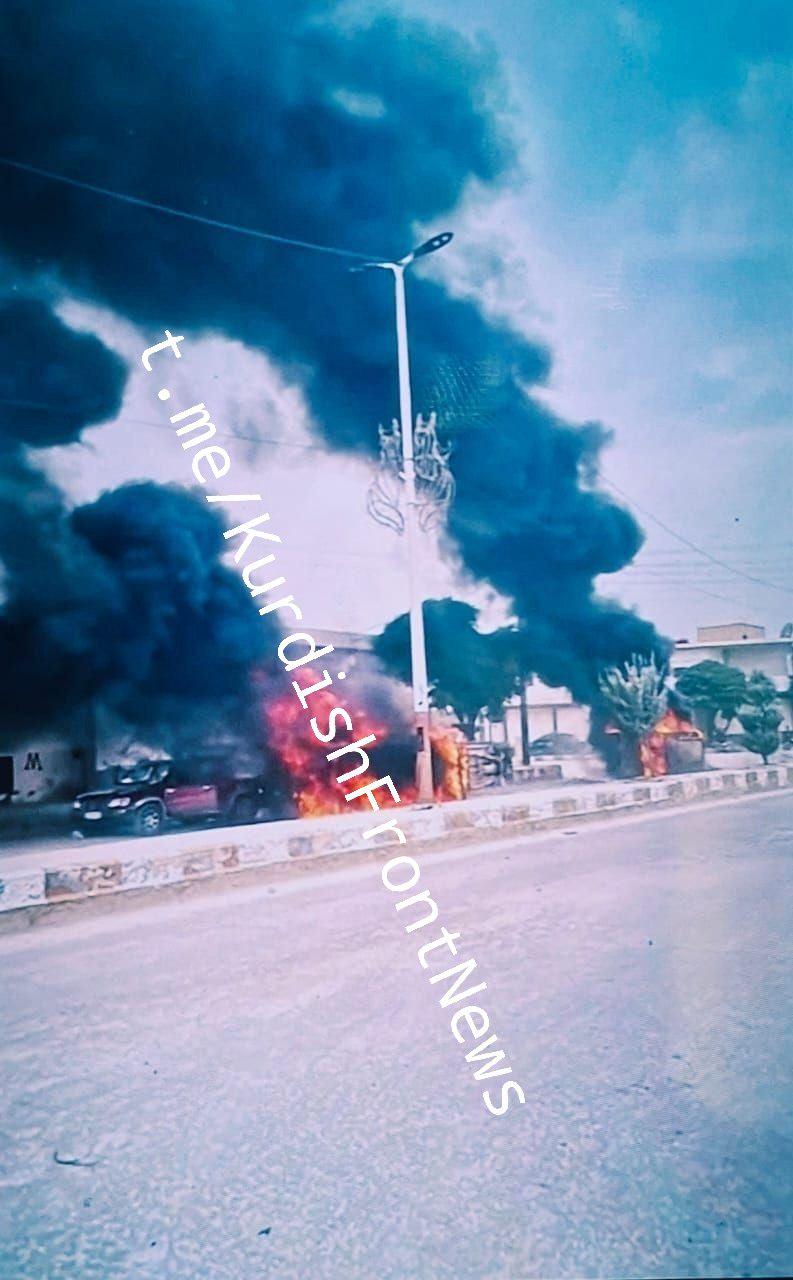
Today, this social organisation is at an inflexion point. At the beginning of 2026, Syrian government forces, jihadist groups and Turkish-backed militias launched a large-scale offensive on Kurdish-administered territories, forcing the Syrian Democratic Forces (SDF) to withdraw from the Arab territories they had administered for years, falling back to the original Kurdish heartland of Rojava. A ceasefire agreement signed at the end of January required the SDF to formally cede key territories, renounce strategic oil fields, and integrate individually into the Syrian army, without recognition as an autonomous force. For many within the movement, this amounted to capitulation: the surrender of 14 years of revolutionary construction under threat of a war of extermination.
What the Damascus government offered in return was telling: recognition of Kurds as a cultural minority – the right to speak their language, to preserve certain identity expressions – but no autonomous Kurdish-language education system, no constitutional recognition of self-determination, no structure of self-governance whatsoever. Political autonomy is destroyed by military force; cultural identity is granted as a gesture of tolerance. This is the characteristic hypocrisy of state multiculturalism: erasing real power while preserving folklore.
This development does not invalidate what Rojava built – on the contrary, it makes it more urgent to understand. It shows that anticapitalist peace faces not only the direct violence of war, but also the structural violence of the state and the market, which seek to reclaim territories where people organised themselves differently. And it demonstrates that this form of organisation was real enough, threatening enough to the established order, to be deemed worthy of destruction.
Despite the current situation in Rojava, the sense of everyday peace that cooperativism fosters among and within communities that I observed over the course of my fieldwork has led me to reflect more specifically on the role of cooperatives in post-conflict and peacebuilding contexts. In fact, for the past two years, peace negotiations are once again underway between the PKK and the Turkish state; one of my aims in writing this essay is to make the case for cooperatives to be on the agenda for a potential peace agreement. It is in this context that I became interested in the role cooperatives have played in Colombia, following the peace agreement in 2016 between the Colombian government and the FARC-EP, the country’s largest rebel group.
The accord, signed after more than half a century of armed conflict, was described by the Kroc Institute for International Peace Studies at the University of Notre Dame in Indiana as the most comprehensive of the 34 agreements signed worldwide since the end of the Cold War. Among its notable innovations was a proposal for the collective reincorporation of ex-combatants through cooperatives and other associative forms of a social economy.
The project must sustain itself within the capitalist market even as it attempts to transcend it
During negotiations, the FARC-EP had challenged the UN’s classic disarmament, demobilisation and reintegration model. The FARC’s primary argument against this model was that it prioritised individual adaptation to the labour market and that this amounted toaccepting the unjust order they had spent decades fighting. Instead, they proposed ‘reincorporation’ – a form of integration that recognised the political agency of signatories and their intention to continue the struggle for social transformation, now through civilian means.
This is how ECOMÚN (Economías Sociales del Común, or Social Economies of the Commons) came to be in 2017: a federation comprising approximately 6,200 peace-agreement signatories and 154 organisations across 26 of Colombia’s 33 administrative divisions. I attended its governing council assembly in 2024. What I found most significant about ECOMÚN was that none of its cooperatives – for coffee, cattle-ranching, fish-farming, textiles, rural tourism, to name a few – were composed exclusively of ex-combatants. Rather, they worked alongside peasant farmers, Indigenous peoples, Afro-Colombians – local communities who share histories of exclusion and dispossession. ‘We have fostered connections between people,’ Juan Camilo Londoño, ECOMÚN’s executive director, told me. ‘There are even organisations that are not signatories but have joined ECOMÚN.’ Internally, the movement describes this as a ‘pedagogy of peace’: the transformation of former war territories into spaces where people on opposing sides of the conflict build productive projects together and, in doing so, weave new social relations.
Yet, as its own leaders acknowledge with clear-eyed honesty, ECOMÚN operates under a fundamental contradiction: the accord did not guarantee the anticapitalist transformation that genuine peace would have required. The question of land tenure – the heart of the FARC’s struggle for decades – was negotiated but never translated into terms that guaranteed real agrarian reform. The project must sustain itself within the capitalist market even as it attempts to transcend it. Its viability depends on volatile political conditions and on international cooperation, which frequently imposes its own neoliberal logics. And because it emerged from the peace agreement, it operates within Colombia’s legal framework and under direct oversight from state agencies. ECOMÚN, in other words, cannot claim Rojava’s autonomy: it is woven into state institutions rather than built in parallel to – or against – them. What self-management it achieves is real, but limited.
What Rojava and ECOMÚN have in common is not their context – one is a revolution in the midst of war; the other is a post-conflict process within a capitalist state – but their wager: that peace is built from below, when people recover control over their time and territories, their cultures and economies.
Both cases also demonstrate that real peace is inseparable from anticolonial and antiracist struggles. For decades, the Kurdish people were denied recognition as an ethnicity, forbidden from speaking their language, and dispossessed of everything that belonged to them: their identity, but also their subsistence economies, their ways of organising themselves, their ways of inhabiting the land. In Rojava, therefore, cooperatives are spaces where the social fabric torn apart by decades of forced assimilation is reconstituted, and where power over one’s own life is recovered. Meanwhile, in Colombia, ECOMÚN’s cooperatives are organised in territories where peasants, Indigenous peoples and Afro-Colombian communities have been, over centuries, systematically dispossessed of their lands. The pedagogy of peace that emerges from these initiatives goes beyond reconciling former enemies – it reconstitutes collective identities that the nation-state and the market had reduced to subalternity, and undoes the manufactured hostility between groups set against each other through systemic poverty and violence.
But it would be a mistake to read these experiences only as responses to extreme situations – as solutions for those living in war zones or conditions of severe poverty. That reading reproduces, perhaps without intending to, the very logic it criticises: the idea that the problem lies over there, in places that have not yet reached capitalist ‘normality’, and that the solution lies in economic development that will better integrate them into the logic of the market.
Peace is not a state reached by signing a document but a way of living together each day
The rhythm of life I observed in Rojava – working until 2.30-3 pm, then going to the assemblies – is precisely what capitalism denies to most people in the world, not just those living in conflict zones. The urban worker who leaves home before dawn and returns at night, too exhausted to speak with their children; the woman whose care work is invisible to the economy and the state, who never rests because her work never ends; the debt-ridden professional who works to pay for what they need to keep working; the young person who sees no horizon in the future; the children who grow up without spaces to play. All of them experience forms of violence that have no name in peace debates but are deeply felt in daily life.
The Guatemalan ex-combatant’s question – What now? – is a question that might be asked not only by someone who survived war but also anyone who works without knowing why, who consumes without feeling satisfied, and who lives with the sense that something essential has been taken from them. Cooperatives are not the only possible answer to that question, but they do propose something that the dominant peacebuilding paradigm – and the economic system that sustains it – systematically refuses to admit: that peace is not a state reached by signing a document but a way of living together each day, of recovering self-determination over one’s own time, needs and relationships, of asking the question How do we want to live? and believing that it can be answered through collective deliberation, by people themselves, without bosses or owners.
This is what the Guatemalan ex-combatant did not find when he came down from the mountains, and what the cooperatives of Rojava and Colombia are trying to build – under very different conditions, with enormous contradictions, but with a clarity about the goal that peace agreements signed in conference rooms rarely possess. Galtung proposed that we dismantle the structures of violence and called what remained ‘positive peace’ – but an anticapitalist peace does not just settle for the absence of structural violence, it dares to ask what should take its place. And it answers with bread baked by hand, milk shared before it is sold, assembly meetings where people still have time and energy to decide. It rests on a form of togetherness in which life itself is harmonious and worth wanting, built each day, from below, through real practice.
This essay is supported by a grant from the Open Society Foundations.