The original operating system was VirtuOS, similar to MS-DOS and includes multitasking support, was developed by Microbase. It was used in the 1996, 1998 and 2000 elections. In 2002, Unisys was unable to renew their partnership with Microbase, and were unable to reuse the VirtuOS based code. Microsoft stepped in, and provided licenses for the Windows CE operating system free of charge. In 2008, under initiative from the TSE Electronic voting team migrated to a Linux (dubbed UEnux) OS to reduce costs and take full control of development cycle.
- From Wikipedia
Thought this was a fun thing to share given yesterday's elections and how fast the votes were tallied.
Saw this post on Bluesky and having had casually followed the trashing of X for about 20 years, the whole Canonical/Mir fiasco, and finally the extremely slow adoption of Wayland, this was cool to see! 😁
I used AI to help with the mechanical parts of porting (e.g. translating autotools to CMake, replacing ioctl calls with tcgetwinsize, translating the C structs into Rust), as well as to write some of the smoke tests (e.g. cairo-test, mesa-test).
Where Claude really shines though is in reviewing your own commits. You give it a hash, and it tells you about the silly memory leak or deadlock that you left in, before you can make a fool of yourself.
For a while my PC froze about twice a day. Not a crash I could recover from: the screen stopped, audio sometimes kept going, and even Ctrl+Alt+F3 did nothing. Only the reset button helped.
After a reboot, journalctl -b -1 -k showed the same pattern every time:
NVRM: dmaAllocMapping_GM107: can't alloc VA space for mapping.
NVRM: nvAssertOkFailedNoLog: Assertion failed: Out of memory [NV_ERR_NO_MEMORY]
NVRM: Xid (PCI:0000:03:00): 56, ...
NVRM: krcWatchdog_IMPL: RC watchdog: GPU is probably locked!
The process that hit it first changed. Once it was a Godot game I'm developing, twice it was Brave (its Media process died with SIGILL right before the lockup). So it wasn't one bad app.
nvidia-smi -q | grep -A3 BAR1 showed the problem: BAR1 was only 256 MiB. Without Resizable BAR, the driver maps GPU memory for the CPU through that small window, and when it fills up, the open driver can lock the whole GPU instead of just failing that one request. There's an open upstream issue with the exact same logs from people on Fedora, Bazzite, Arch and CachyOS, mostly with Chromium-based browsers or Discord as the trigger:
My BIOS had "Above 4G Decoding" but no Resizable BAR option. It turns out Huananzhi publishes an official BIOS for the X99-BD4 with ReBAR added, on the board's download page. I flashed it, enabled Above 4G Decoding and Re-Size BAR, and now:
BAR1 Memory Usage
    Total : 8192 MiB
No VA errors in the kernel log since, no freezes, and the whole system feels smoother, including games.
If you have an NVIDIA card on an older board and see "can't alloc VA space" before a freeze, check your BAR1 size. A lot of X99 and other older boards have official or community BIOS updates that add ReBAR. Flash carefully and only the file for your exact board model. If you can't enable it, people in that issue report that turning off hardware acceleration in Chromium-based browsers makes it happen much less often.
I'm developing Linux Subsystem on Android (LSA), an experimental project that runs a native Linux userspace on rooted Android devices while keeping Android as the host operating system.
The goal isn't just to run a Linux desktop. I'm trying to make Android's hardware and services usable through normal Linux interfaces, without requiring applications to be rewritten for Android.
LSA uses the Android kernel directly. It's not PRoot, emulation, or a VM.
What's currently working in development testing on a Blackview N6000:
Debian ARM64 with a graphical desktop and native Linux applications
Hardware-accelerated OpenGL through Mesa/VirGL and Android's GPU stack
Audio playback and microphone capture
USB storage integration, including automatic NTFS mounting
Applications including Firefox, OpenArena, and SuperTuxKart
This is still pre-alpha. Some applications require workarounds, graphics compatibility is incomplete, and hardware support varies. Some of the results above are from a private development preview and may not be present in the current public release.
I'm looking for people who have spare rooted Android phones and are willing to help test LSA on different hardware.
Useful experience includes Android rooting, ADB, Linux debugging, shell scripting, Mesa/VirGL, graphics drivers, audio, and embedded Linux. You don't need to be an expert.
There are two ways to help:
Independent testing: Try LSA on a spare device, collect logs, report bugs, and share hardware compatibility results. No remote access required.
Direct development collaboration: For volunteers who want more involved help, I'm open to supervised SSH debugging on a dedicated test device. Any access would be optional, explicitly authorized, and governed by a written agreement restricting my activity to the agreed testing and development work.
Please don't run this on your primary phone or anything you can't recover. This is experimental rooted system software, and things can break.
If you're interested, let me know your phone model, chipset, Android version, and rooting method.
I'm also looking for feedback from people familiar with Linux systems programming or Android internals.
Thanks!
Disclaimer:
This project has been developed with the assistance of AI. I'm not an expert in every field this project covers, and I don't claim to be. LSA is an experimental learning project, and I welcome technical feedback, corrections, and contributions.
I wanted to share a project that's been making some interesting progress in PC-based home theatre.
CroqueMr (u/Croque_Mr) is developing native Dolby Vision support for Kodi through a custom LibreELEC build, including Profile 7 FEL reconstruction. Development has moved quickly, with regular releases bringing performance improvements, new rendering modes and broader hardware support.
What's currently available?
Native Dolby Vision playback, including Profile 7 FEL reconstruction.
Intel and AMD support, with NVIDIA support also being developed.
Dolby Vision rendering modes, including Master Reference and Adaptive HDR Mapping.
Dolby Vision-to-HDR10 conversion and experimental AI-assisted HDR10-to-Dolby Vision conversion.
Blu-ray 3D support on compatible AMD hardware.
Performance optimisations targeting lower-power mini PCs, including Intel N100/N150 systems.
The latest Beta 5 release includes further improvements to playback stability, FEL handling, scaling and display detection. Results and compatibility can vary depending on the hardware, TV, source material and rendering mode.
What's coming next?
The developer has outlined plans for a GPLv2-or-later licensing rebuild, further AMD improvements, HDR10+ support and Dolby Vision-to-HDR10+ metadata reinterpretation, alongside expanded compatibility with older Intel graphics and additional NVIDIA hardware.
The longer-term goal is to make PC-based Dolby Vision playback more capable and accessible, including on affordable mini PCs.
Full credit to u/Croque_Mr for the development, along with the community members contributing testing, feedback and improvements.
It's been impressive to see how much the project has evolved in such a short time. If you're interested in the technical details, supported hardware or latest builds, the links above have all the information.
Flatpak needs bubblewrap, bubblewrap needs user namespaces, and Android kernels ship without them. So flatpak run can't work on a phone, root or not.
In Tessera (GPL-3.0, an Android app that runs Linux desktop apps as native Android windows), flatpak still downloads, but Tessera builds each app's root itself:
- the runtime at /usr and the app at /app, read-only;
- the runtime's GL extension where the runtime expects it, on a tmpfs over its parent since the folder doesn't exist in the read-only runtime;
- /etc from the runtime, with passwd, group, hosts and resolv.conf written for the session;
- the session's X11 directory shared, carrying its D-Bus and PulseAudio sockets, so the app gets the same bus, sound and theme portal as the Debian side.
Without root that's PRoot's path translation. With root, each launch gets a private mount namespace, an unprivileged uid and no_new_privs, so per-app permissions are kernel-enforced.
The rest is about making Linux apps feel native on a phone: each app (and each of its windows) gets its own Android task and Recents card; GTK, libadwaita and Qt take Material You colors and follow dark mode live through a settings portal Tessera serves; apps rescale live from a slider; and the Android keyboard opens on text fields by listening to AT-SPI focus events. GPU acceleration is a bundled Mesa with Turnip and Zink for Adreno, which also loads inside Flathub runtimes.
You can find two proprietary driver versions on the Lenovo website. One is the "Linux version" which requires OpenSSL 1.1 and the other is the "Ubuntu version" which requires OpenSSL 3. Both are .so libraries that work on any distro if the requirements are satisfied. Use the second one.
Depending on your distro, you also need to choose one way to obtain the libfprint-2-tod.so.1 library. Alternatively, you can build it from this source using meson/ninja.
Hi all, AdobeWine 0.3.1 is out. It's a patched Wine (11.18 plus 90 patches) that runs Adobe's Creative Cloud apps on Linux. You install the apps yourself with Adobe's own Creative Cloud installer and your own subscription; nothing from Adobe is bundled or downloaded by the project.
This time there's a video: a short showreel made entirely in the Adobe apps on Linux, from a pen-pressure painting in Photoshop to the cut in Premiere and the export in Media Encoder:
(To be upfront: the pen strokes come from a simulated tablet and most steps were scripted. The point is that the apps themselves run, draw and render correctly.)
What works right now (tested on an RTX 4070 laptop, with community reports on RTX 4060, RTX 4090 and Intel UHD 620):
Creative Cloud desktop: sign in, install/update/open apps, Fonts, Files; its own self-update completes
Photoshop: layers, masks, type, filters, Remove Background, Generative Fill, export. All 75 filters and adjustments I tested give the same output as on Windows. Pen pressure works
Illustrator: shapes, pen, type, effects, Pathfinder, Image Trace, save/export, Blob Brush with pen pressure. 107 of 139 reference outputs match Windows (the rest not compared yet)
Premiere Pro: import, timeline editing, Lumetri, titles, playback, NVENC export, Dynamic Link with After Effects
Media Encoder: queue, presets, CUDA renderer, NVENC/NVDEC
After Effects: scripting, keyframes, 3D text with the Cinema 4D renderer, the composition viewer with CUDA; a real 300-layer project renders like on Windows
InDesign: styles, tables, placing PSD and AI files, PDF export
Pen tablets with pressure under XWayland, no extra software
Not there yet: AMD isn't confirmed (a Premiere fix is waiting for someone to test it), AMD and Intel GPUs don't get the CUDA features, After Effects can eat a lot of RAM while previewing heavy 3D comps, and Bridge is barely tested.
It's free, open source and non-profit.
A word on AI, since it always comes up: AI slop is bad, the same way anything pre-produced and left unfinished looks bad. People who produce slop are, in fact, sloppy: they don't care to finish and finalize their ideas. This project is a construction, ongoing, and it needs the community. Even though it was done almost entirely with AI, it's driven by a human, and it's meant to help other people in their lives.
So if you use Adobe and Linux (or would like to), please try it and tell me what breaks, especially on AMD and Intel GPUs, other distros and your real workflows. Issues and PRs are welcome, and so are plain "it worked for me" reports.
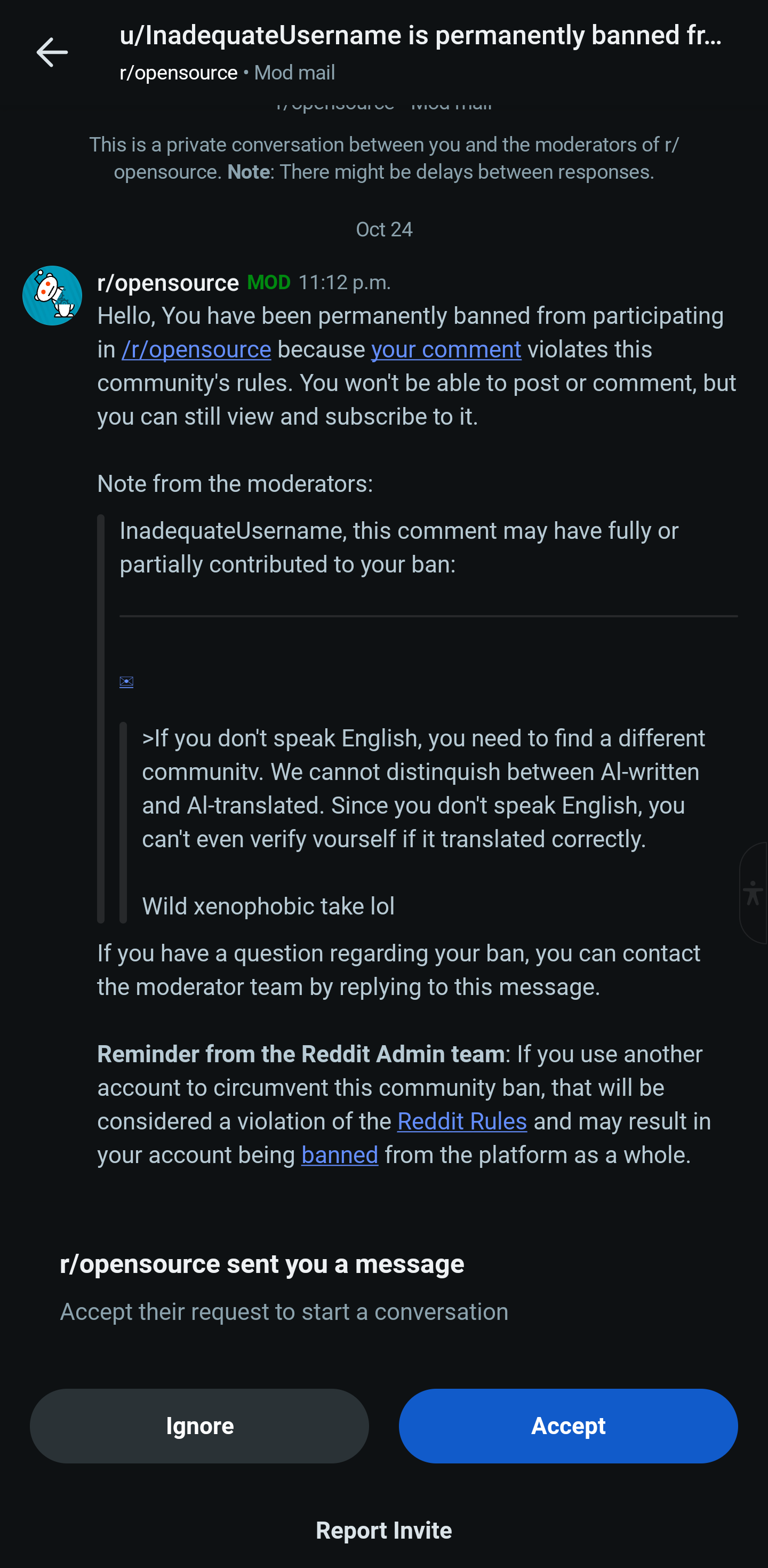
I understand the need for controlling the onslaught of low effort projects, but surely declaring that you are English only goes against the site's rules?
just because it's a lingua franca doesn't mean it's superior. Users should be allowed to share their opensource contributions with the Reddit community in the language of their choice.